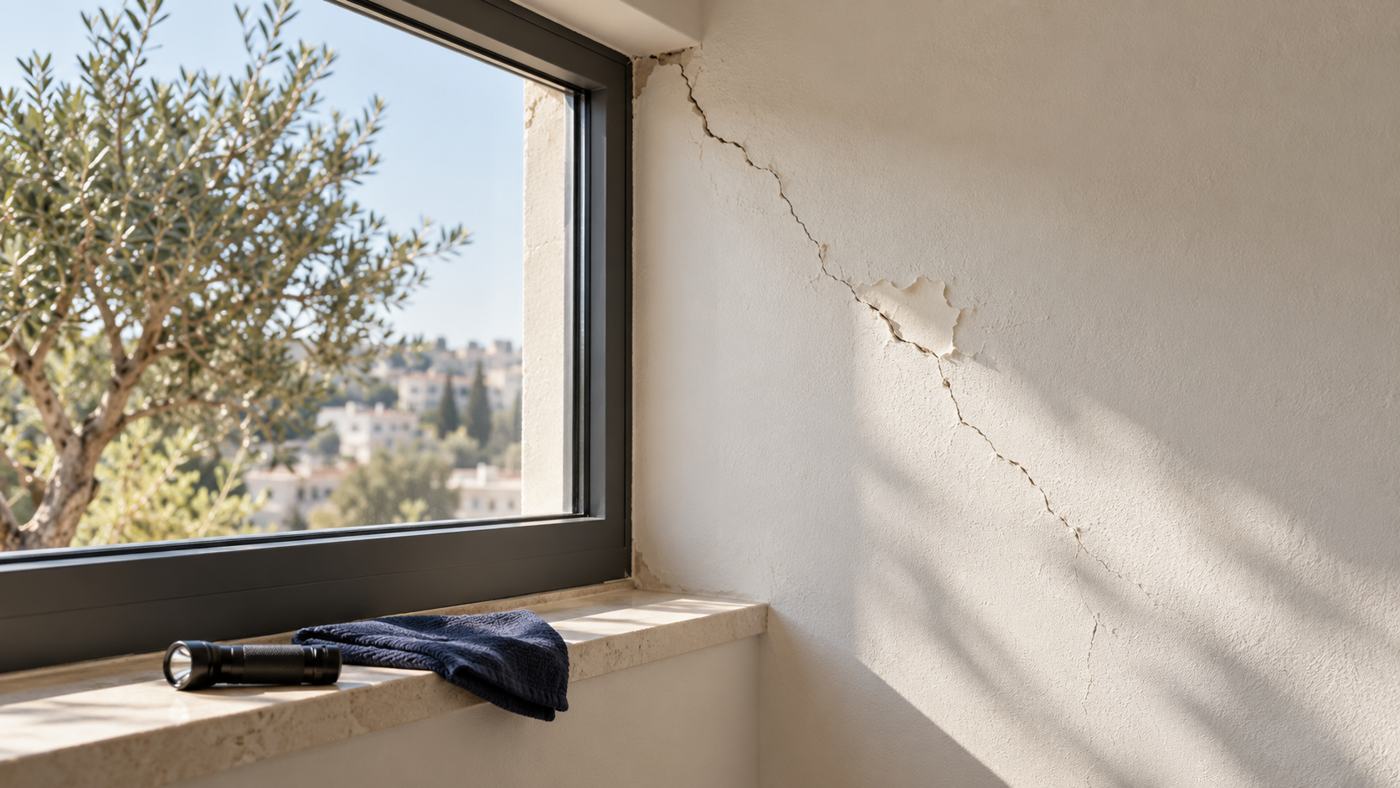
The house committee of an apartment building in Nahariya and one resident sued the developers over mosaic tiles falling from the outer walls, alleging a hidden structural defect. The court dismissed the claim, mainly on limitation grounds, and ordered the plaintiffs to pay ILS 80,000 in costs.
What happened
The building was built in the late 1990s, received its occupancy permit ("Form 4") in March 1998 and was occupied in 1998 and 1999. Its outer walls are clad in mosaic tiles, and it stands about 500 meters from the sea. In December 2023, some 25 years after occupancy, the condominium committee and one of the apartment owners sued the developers who had built it.
According to the plaintiffs, in 2019 parts of the outer walls began to deteriorate and fall, and only from the report of an engineer they hired that year did they learn the problem ran deeper: concrete cover over the steel bars that was too thin, causing water penetration, rust and the cladding being pushed outward. In their view this was a "fundamental nonconformity" under the Sale (Apartments) Law, affecting the building's stability and safety. They asked for an order to carry out repairs or, alternatively, compensation, and valued the claim for court-fee purposes at ILS 2,000,000.
The developers argued that the claim was long time-barred, that residents had known about the falling tiles for many years, and that the problem came from natural wear and lack of maintenance.
The ruling: the claim is time-barred
The limitation period for such a claim is seven years. The plaintiffs relied on the "late discovery" rule, under which the period starts only when the damage or the facts behind the claim become known to the plaintiff, provided they could not have discovered them earlier with reasonable care. The court rejected this:
- The evidence showed that tiles were visibly falling from the early 2000s and that the problem grew worse over the years. Residents stated they had noticed it over the years, and the plaintiff himself confirmed he saw it until 2017. The attempt to describe it as "a stone here, a stone there" was not accepted.
- No particular worsening in 2019 was proven. According to a committee member at the time, what prompted the residents to act was the success of a similar lawsuit by a neighboring building.
- The discovery date is not set by when a plaintiff chooses to commission an expert report. Someone who sees signs of damage must have them checked within a reasonable time. Here, for years, the residents did no engineering inspection, did not contact the developers and did not maintain the cladding.
- The court also held against the plaintiffs that they did not file the original 2019 expert report, although they were required to, and that they waited more than four more years before suing, despite the safety hazard they said they had discovered.
The court distinguished this case from the ruling on the neighboring building, which had previously been inspected by two engineers who did not detect the hidden damage. Here, by contrast, no inspection had been done at all.
On the merits too: no liability proven
Although it did not need to, the court also examined the plaintiffs' arguments on the merits. The court-appointed expert had attributed 72.5% of the responsibility to the developers, mainly for faulty tile bonding. The court departed from her conclusion: when the building was built there was no Israeli standard for bonding mosaic tiles (one was adopted only in December 1998), and the expert herself conceded that after 25 years the quality of the adhesive cannot be tested. It also emerged that such cladding in a seaside environment without maintenance lasts about 20 years, and that maintenance is the residents' responsibility.
The alleged defect in the concrete cover was not proven either. The lab report relied on by the plaintiffs' expert was not designed to examine the structure, covered only the ground floor, and its authors could not say whether structural bars had been examined. So no "fundamental nonconformity" in load-bearing parts was proven. In addition, even on the plaintiffs' own version, notice of the nonconformity came almost five years after the alleged discovery, which is not a reasonable time for a defect described as threatening the building's stability.
The outcome
The claim was dismissed. The plaintiffs were ordered, jointly and severally, to pay the developers costs totaling ILS 80,000 within 30 days. In setting the amount, the court considered the outcome, the complexity of the case and the parties' conduct in the proceedings. The deposit the plaintiffs had paid into court will be transferred to the developers on account of the costs. This is a first-instance judgment and can be appealed.
Key takeaways
- Seeing tiles fall from your building? Don't wait. Get an engineering inspection and notify the developer or contractor in writing promptly.
- The limitation period may start from the day you saw signs of damage, not from the day you received an expert report.
- Even after a defect is discovered, you must notify the contractor within a reasonable time. Years of waiting can cost you the right to sue.
- Routine maintenance of exterior cladding is the residents' responsibility. Keep records of it, because without it part of the blame may shift to you.
- In court, file all relevant documents, including earlier expert reports. Withholding them can be held against you and lead to heavy costs.
This article summarizes a published Israeli court decision in plain language and is not legal advice. Every case depends on its facts. The parties' names have been omitted. This is a first-instance decision and may be appealed.